


Another VALOR seminar has come and gone. As I reflect on our time in Richmond, exploring topics in legislative advocacy and policy development, I am blown away by the meaningful learning opportunities and connections that took place over the course of just three days, from the hallowed halls of the Governors Cabinet Room to the basement of the Capital Ale House. During seminar III, I sharpened my ability to convey my opposition to utility-scale solar fields in our rural communities, identified parallels between marketing and legislative advocacy, picked up some valuable leadership principles from state leaders and some of the strongest champions of agriculture in the Commonwealth and much more.

Before I share my major takeaways and the experiential learning that took place, I would be remiss if I did not acknowledge the elephant in the room. Our VALOR trip to Richmond was far from ordinary. On Monday, Jan. 6, a power outage caused a malfunction of the city’s reservoir system during the first winter storm of 2025. In the days after, water service was cut off in the City of Richmond. By Jan. 9, water was circulating, but a boil water advisory was in effect. As a result, the general assembly recessed for the entirety of our visit and most state office buildings closed. Our program director, Megan Seibel, was nimble and called in a few favors. We were fortunate to enjoy the majority of our original programming, with some minor shifts. I’d like to thank Megan, the numerous state officials and others who stepped up to ensure our cohort enjoyed an extremely worthwhile and valuable seminar in Richmond.
To kick off our seminar, VDACS Commissioners Joe Guthrie and Deputy Commissioner Charles Green, were kind enough to join us in the meeting room of our hotel, as the Oliver Hill Building was closed. They shared the scope of VDACS and its role in animal and food industry services, marketing and development, consumer protection and commodity services. VDACS’ is responsible for many of the ag programs we know and love, such as the Virginia’s Finest and Virginia Grown programs, the milk commission and AFID grants, but did you know they are also responsible for regulating fantasy sports and charitable gaming? VDACS’ oversight is both diverse and all encompassing.
Following the review of VDACS and its integral role in supporting Virginia agriculture, both the Commission and Deputy Commission shared their career path and leadership trajectory, as well as their personal principles related to leadership. Commissioner Guthrie said, “leadership is service,” which is true, particularly in the advocacy arena, but also in the corporate world. Engaging in local government and community organizations, joining boards and advisory committees, mentoring employees and/or youth; all of these activities require time and energy. That time and energy is expended to bolster a community, an industry, an organization or an individual. Another tip that Commissioner Guthrie shared was to “stay in your lane” in a leadership position, i.e. know your area of expertise and call upon others early and often when it benefits your ability to make an informed decision. Lastly, he said, “Don’t let the people doing it wrong win,” or be willing to fight the good fight when you recognize injustice or incompetence. To grow your influence and authority, the Deputy Commissioner Green recommends, “always be the person that volunteers.”
Next, Delegate Robert Orrock joined us to share his role and some insight on the solar field debate, which our cohort had been tackling. The Delegate is a former VA FFA State Officer and high school ag teacher. He has served the House since 1990. On the topic of solar projects, Delegate Orrock emphasized the limitations associated with storage infrastructure, issues related to the variability of solar energy and the sheer acreage that would need converted (i.e. destroyed) to meet the standards of the Virginia Clean Economy Act. Through solar field implementation, more than half of Virginia’s prime ag and forestry land would require conversion. Is the juice worth the squeeze? Not even close, in my opinion.
If the goal of solar energy is to advance sustainability, how does decimating a 7,000-acre tree farm in Spotsylvania County, Va. to erect solar fields and destroy the land for future agricultural use achieve that? Orrock said, “Dominion is not the ogre. They are just trying to comply with clean energy policy.”
Another crux of the issue is that the goal post is moving mid-game in regards to clean energy policy and energy consumption. Governor Ralph Northam signed the Virginia Clean Economy Act into law in 2020, which requires 100% renewable electricity by 2050. Since then, energy consumption rates in Virginia have increased exponentially and they will continue to. Virginia is the #1 state in the country for data centers to explore AI systems and application. These data centers have huge electricity needs.
There are alternatives to utility solar field installation. In most communities, dual-purpose solar projects are a more palatable approach, in which solar panels are installed on existing infrastructure. Additionally, nuclear energy via small module reactors is looking promising for utility-scale energy generation, although research and development is ongoing.
Following Delegate Orrock, Senator Timmy French joined us. Currently, Senator Timmy French and Delegate Michael Webert are the only general assembly members who are currently involved in production agriculture. It is difficult for our legislators to understand our farmers’ pain points and the policy, which influences them. “You don’t know what you don’t know,” he said.
The senator shared a story in which a delegate inquired about his poultry production and whether or not the chickens were processed at his farm. Senator French shared the relationship with his integrator and that the majority of his flock would be processed for Chick-fil-a, which does not use dark meat. The delegate asked, “Then, why do you even raise dark meat chicken if they are not used?” Again, you don’t know what you don’t know…
When pitching ag policy, the senator doesn’t frame it to support “the farmer down the road,” as most of his counterparts are too disconnected from those individuals and their needs, instead he promotes policy which encourages a safe and abundant food supply, which every constituent relies on. Legislative advocacy and policy development is a lot like marketing, you have to know your audience and frame your message to resonate with them in order to achieve your desired outcome, whether that outcome is a purchase, an online conversion or a vote.
Expanding on that sentiment, Delegate Orrock shared that when addressing controversial topics in a room of opposition, some concession to the opposing viewpoint can be an effective strategy to win favor. For example, relating to the topic of utility solar fields, the delegate will frequently articulate his opposition by saying, “I am not against solar as a renewable energy source; however…” which makes his opposition and viewpoint more palatable to his colleagues.
On day 2, Secretary of Agriculture and Forestry, Matt Lohr, hosted our cohort in the newly renovated Governor’s Cabinet Room for a round robin with distinguished Virginia officials. Each official shared the scope of their sectoral oversight, as well as how they collaborate with Secretary Lohr and Governor Youngkin to address agricultural topics, including agricultural labor and education needs, solar energy and more.

A key takeaway from Secretary of the Commonwealth, Kelly Gee, regarding her personal leadership philosophy included the importance of surrounding yourself with people who are smarter than you are. In a leadership role of any kind, it is an assumption that you must be the smartest person in the room, or maintain the most knowledge on a subject in which you are addressing, but that is a fallacy. Strong leaders recognize the value in bringing others to the table, which was extremely apparent as we sat in the Governor’s Cabinet Room, where Governor Youngkin is joined each week by his cabinet, who advise his decision-making as it relates to their given sector.

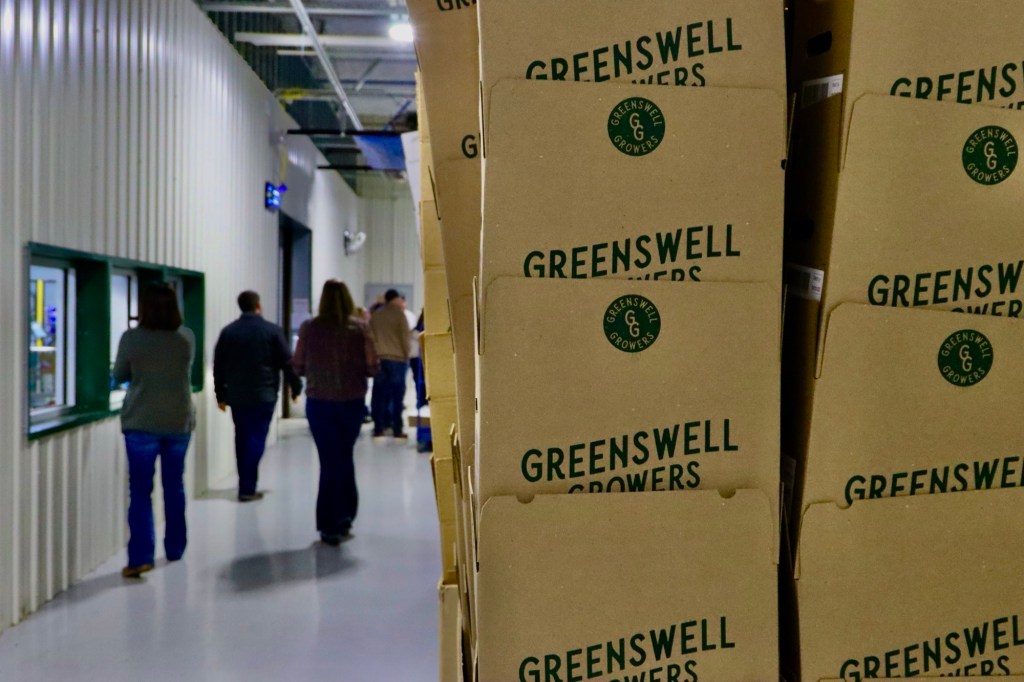
After hearing from each distinguished official, Secretary Lohr shared some of the major wins for the agricultural community during Youngkin’s administration, which include advances in the thoroughbred racing industry as well as the expansion of controlled environment agriculture (foreshadowing our next stop, which was a farm tour at Greenswell Growers in Goochland, Va.). Youngkin has been an effective champion for the agriculture industry. Although he does not have an agricultural background, he recognizes the importance of supporting and advancing Virginia’s largest private industry, with the knowledge-base and trusted insight of his appointees, Secretary Matt Lohr and Commissioner Joe Guthrie, who are both actively involved in production agriculture.
That evening, our cohort planned on attending the heavily-anticipated Virginia Agribusiness Council (VAC) Annual Legislative Appreciation Banquet; however, the event was cancelled due to the ongoing water issues. The VAC Executive Director, Cliff Williamson, who is a VALOR alum, joined us for dinner, as his evening had freed up. That evening, Cliff was slated to speak in front of 1000+ industry champions and legislators at the banquet; instead, he spoke to our cohort of 16 in the basement of the Capital Ale House downtown. Cliff shared the role of the VAC in representing its members and their interests on bills that go before the general assembly. He emphasized networking as the key to career growth and growing your influence, which was another trend that repeatedly emerged during our seminar.
We spent the last day of our seminar at the Virginia Farm Bureau Federation (VFBF) office. Firstly, we participated in media training. One-by-one my cohort members were mic’d up, situated in front of a camera and interviewed regarding the construction of utility solar fields in our rural communities, and whether or not we agreed with state mandates that would require their implementation. In my role, I am typically on the other end of the camera conducting the interview, so I appreciated the experience in the hot seat.

Next, we dug into strengths based leadership via our CliftonStrengths results, led by Dana Fisher, VFBF Senior District Field Services Director and VALOR alum. I completed the assessment a few years ago as part of the Step-Up to Lead program. My top two strengths did not deviate, woo (winning others over) and communication. I also scored high once again on adaptability; however, two new strengths emerged.

One new strength which emerged was developer. The developer skill has to do with cultivating the potential in others. Over the course of the last few years, I have been offered more leadership opportunities, including mentoring a summer intern and advising new colleagues on the marketing team. Between those experiences and my participation in VALOR, I am pleased to see this skill emerge as I continue to identify and practice my developing leadership philosophy.
Lastly, the activator strength rounded out my top 5. The activator skill is associated with serving as a catalyst for action and/or change, which is almost too appropriate of a conclusion for our seminar on legislative advocacy and policy development in Richmond. I look forward to both sharpening and leaning into these strengths over the remaining 18 months of my VALOR experience, as I seek to improve my ability to champion the agriculture industry and preserve Virginia’s rural communities.

 valeadersor.com