


A colleague of mine, a dairy farmer who can talk animal health, equipment uptime, and enterprise risk all in the same sentence, was recently invited to a high level executive engagement. The room was stacked with senior leaders from state and federal government, alongside representatives from the Agriculture industry.
During the pre-event coordination, the organizer offered this suggestion to my colleague: He might consider wearing jeans and a flannel shirt.
First and foremost, there is nothing wrong with flannel shirts or jeans. The problem was not the clothing. The problem was the assumption behind it – that Agriculture is best represented by a stereotype and that credibility in the room is something a producer should perform visually. Professionalism in Agribusiness is not optional, it is a strategic requirement; not because producers need to prove they belong in executive spaces, but because decisions made in those spaces shape the operating environment producers face every day: land use, infrastructure, labor, trade, capital, and technology adoption.
The challenge is that many in those rooms are not seeing the business clearly. They are seeing a shortcut, and shortcuts flatten complexity into something familiar, even when the reality is anything but simple.
The Stereotype Survives Because it’s Convenient
Stereotypes are sticky because they reduce complexity. They compress an entire sector into a single, familiar picture, and Agriculture is one of the most compressed industries in the American imagination: flannel, pitchforks, and simple. That shorthand is convenient for everyone except the people doing the work, and the global communities that depend on them. Once Agriculture gets labeled simple, it gets treated as simple. When you treat a complex system as simple, you make confident decisions that are quietly reckless, such as:
- simple land use and zoning decisions
- simple infrastructure and growth planning
- simple revenue and tax base assumptions
- simple policy tradeoffs
That’s why the flannel suggestion matters. It was not really about clothing. It was a subtle signal, intentional or not, that Agriculture should be kept in a familiar box. We know what a farmer looks like. We know what this is. It’s not complicated.
The truth is, a modern farm is more than an image, it’s an enterprise. It has a real P&L to manage, strategic plans to execute, and technology and infrastructure to sustain. It runs end to end, from input procurement through production and compliance to processors, retailers, and export markets. It carries exposure at every step, animal health and welfare, commodity volatility, fuel and interest rates, equipment uptime and telemetry, and regulatory requirements, all inside timing windows you do not control.
The stereotype is a convenient shortcut, and it has consequences. It shapes who gets taken seriously, what concerns get labeled as overreaction, and how quickly Ag realities get waved off in planning meetings, boardrooms, and policy debates. If the room believes Agriculture is basic, decision makers start treating it like a background variable, something to accommodate only after the “real” priorities are addressed.
That’s why professionalism matters so much. Professionalism is how producers force the conversation to match reality. It is how you translate complexity into credibility, so Agriculture is treated like what it is – a technical, high stakes, enterprise grade industry that underwrites food security, economic stability, and community resilience.
Professionalism Starts at the Farm Gate
During VALOR Seminar VIII in Pittsylvania County, we spent time with Robert Mills Jr., a first generation producer with the kind of discipline and range that leaves an impression fast. A theme from one of our conversations has really stuck with me. First impressions matter, how you care for and present your operation is a reflection of you and your values. His track record as a diversified operator reinforces the point. Professionalism is not a talking point, it is part of how the business is built and sustained.
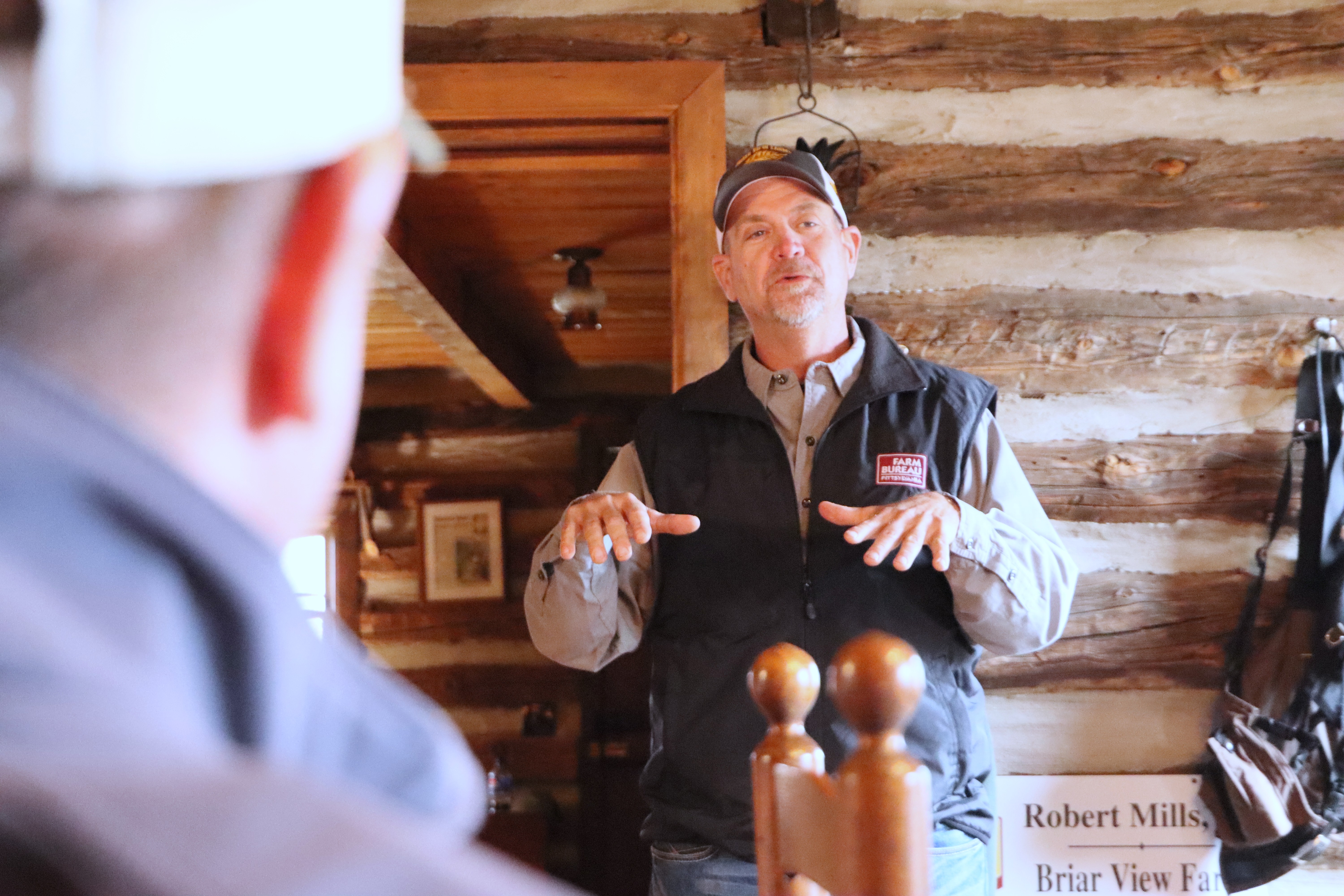
A farm is not just a production site. It is the front door of an enterprise, where lenders, vendors, customers, neighbors, and local decision makers form opinions long before they understand your margins or your management plan. Professionalism at the farm gate is not about trying to look corporate. It is about reducing friction and protecting trust. The best producers treat professionalism like an operating system; it keeps the business legible to outsiders and resilient under stress. In practice, that shows up in a few consistent signals:
- Order and readiness: The property communicates safety, care, and control
- Process discipline: Clear routines, clean documentation, and consistent execution
- Communication: Direct, timely, with customers, regulators, and industry partners
- Pride without performance: Standards that speak for themselves
Those signals are not superficial. They connect directly to how a professional farm is run, balancing technical execution with leadership, planning, and disciplined management.
The Modern Farmer’s Skill Set is Enterprise Grade
Modern farming is not a single job, it’s a stacked set of roles, technical, mechanical, financial, and strategic, often carried by the same person. If you only judge Agriculture by what is visible from the road, you miss the decision stack underneath it. A modern producer has to be competent across disciplines that most industries divide into departments:
- Biology and animal welfare: nutrition, reproduction, genetics, biosecurity
- Agronomy and horticulture: soil health, input strategy, pest pressure, yield risk
- Mechanical systems: maintenance, calibration, readiness, repair
- Technology and data: precision workflows, sensors, telemetry, documentation
- Finance and governance: budgeting, credit, cash flow, capex, succession
- Market and supply chain: contracts, basis risk, logistics, timing, labor constraints
If you extracted any one of these lanes and made it a full time job, it would still be a respectable career. Many producers carry the full system, and they execute under constraints that cannot be rescheduled. That is why the “simple” stereotype collapses under even a basic look at reality. A modern producer has to operate like an executive and a technician at the same time, switching between hands on problem solving and board level tradeoffs daily.
And this is where professionalism becomes the stabilizer. When your job spans this many domains, professionalism is what keeps the operation coherent. It turns complexity into consistency, and consistency into trust, whether you are talking to a lender, a regulator, a customer, or your own team.
Technology is embedded in day to day production, not as a novelty, but as an expectation. Precision workflows, sensor driven decisions, and data backed input management demand disciplined execution. Take variable rate technology:
- USDA Economic Research Service reports that corn acreage using variable rate rose to 37.4 percent in 2016, up from 11.5 percent in 2005, a sharp shift in how inputs are managed at scale. That is not just buying equipment, it is running a repeatable system, collecting data, building prescriptions, calibrating, executing, and verifying outcomes. The tool is only as good as the process behind it.
- The same ERS work shows precision technology use is widespread and increasingly tied to farm scale. For example, guidance autosteering systems were used by 52% of midsize farms and 70 % of large scale crop producing farms in 2023. That is a clear signal of where the sector is going. Technology is not optional for competitiveness, and the execution burden lands on the operator.
At the same time, the broader digital agriculture market is scaling quickly. Global Market Insights estimates the digital agriculture market was valued at over $22 billion dollars in 2023, with continued growth projected through 2032. Whether someone agrees with any single forecast or not, the direction is unambiguous, and investment is flowing toward technology enabled productivity, traceability, and operational efficiency.
This ties directly to the bigger global picture. Virginia Tech reported on the 2024 Global Agricultural Productivity work that productivity growth is not keeping pace with projected needs. The executive summary cites global average annual total factor productivity growth around 0.7 percent during 2013 to 2022, below a stated target around 2 percent. That gap closes when producers can adopt innovation responsibly, finance it, integrate it into operations, and execute consistently in the real world.
Education Trends are Changing the Profile of Ag
Another one of the quiet contradictions of the “simple farmer” stereotype is the education trend line. The data show Agriculture is becoming more credentialed, more technical, and more populated by people deliberately choosing the sector.
National Center for Education Statistics reports bachelor’s degrees in agriculture and natural resources rising from nearly 27,000 in 2009 to 2010, to almost 42,000 in 2019 to 2020.
ERS also reports a measurable difference in educational attainment between beginning and established principal operators. In 2016, 36.2% of beginning farm principal operators had a four year college degree or higher, compared to 26.8% of established principal operators.
That is not a value judgement, it is simply what the data show. New entrants are arriving with higher levels of formal education. This matters for professionalism because it changes expectations. A more educated pipeline tends to bring stronger comfort with planning, recordkeeping, technology adoption, compliance, and stakeholder communication. Those are not extras in modern Agribusiness; they are core operating requirements.
As Agriculture becomes more technical and more professionally credentialed, the gap widens between what the sector actually is and how it is still treated in many local planning rooms and policy debates.
Why Professionalism Matters in Decision Rooms
This is where the stereotype becomes expensive. Local and regional decisions are often made by people who do not live inside Agriculture’s complexity. They live inside timelines, budgets, and competing priorities. When Ag shows up in those rooms as a simplified character, it gets handled like a simplified variable.
In my work with the Suffolk Agriculture Advisory Committee, I have seen how quickly Agriculture can be treated as background, like a line item to accommodate after the “primary” agenda is set. That happens most often when the room does not recognize farming for what it is, a capital intensive, often multimillion dollar enterprise with long investment cycles, regulatory exposure, logistics constraints, and daily risk management that most industries spread across entire departments.
Professionalism is how producers close that gap. It is not about trying to sound corporate, it is about making the business legible in the language decision makers already use. The most effective Ag voices translate lived reality into terms that survive a policy meeting, a budget review, or a planning session. That translation is practical. It looks like clear documentation, clear asks, and clear tradeoffs:
- What are the direct impacts to production capacity and day to day land use
- How does this decision contribute to the slow depletion of working lands, and where is the regional tipping point that collapses supporting Ag industry
- What second and third order impacts follow, including processing capacity, logistics, labor, and supplier networks as volume declines
- What enterprise responsibility is being shifted onto producers, and what mitigations are realistic and enforceable
When producers show up with that level of clarity, professionalism becomes leverage. It forces the conversation to match reality, it makes it harder to dismiss Agriculture as “basic,” and it protects the sector’s ability to compete for attention, resources, and long-term planning consideration.
Closing Thoughts
VALOR has accelerated my understanding of what real Leadership in Agriculture looks like. It is grounded in local realities, weather, soil, labor, land use, and community relationships, but shaped by markets, policy, infrastructure, workforce pipelines, and consumer trust. Each seminar expands perspective by putting you face to face with producers, regulators, educators, and innovators, then challenges you to translate those insights into action back home. That process builds more than knowledge, it builds professional range.
And that is what the stereotype misses. The modern producer is not trying to act professional, they are professional, often operating at a level of competence that would be recognized in any executive forum if the audience was not stuck on an outdated mental image. Agriculture professionals also tend to be exceptional cross-domain communicators, translating between technical realities and business outcomes, between operational constraints and public expectations, between local land use and national food priorities.
So, if someone wants to suggest flannel as a way to “look” like a farmer, they are missing the point. The modern farmer is a technical operator, a business executive, a risk manager, and a systems integrator, often all before lunch. If we’re being honest, the modern farmer just might possess one of the broadest skill sets in society today.
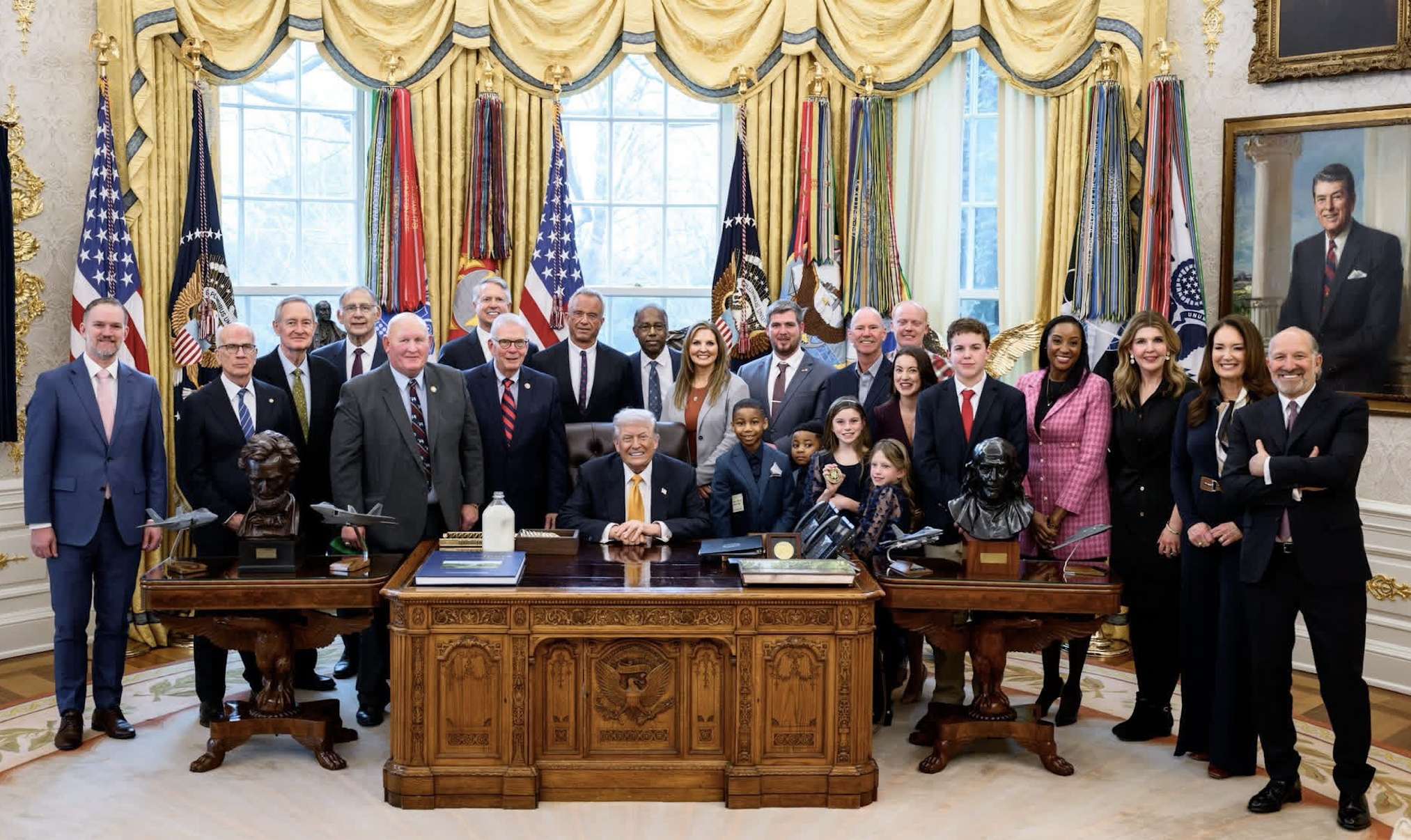
Pictured is my friend and colleague, Thomas French, at the White House in January, for that high-level executive engagement I mentioned previously. It was for the signing of the Whole Milk for Healthy Kids Act. This is exactly the point of this post, modern producers belong in these rooms, not as a stereotype, but as professionals shaping policy and outcomes.
Here are some good references if you are looking for more information.
- Agnew, J. L., & Nakelse, T. (2024). 2024 global agricultural productivity report: Powering productivity: Scaling high impact bundles of proven and emerging tools (T. Thompson, Ed.). Virginia Tech. https://hdl.handle.net/10919/122738
- Global Market Insights. (2024, February). Digital agriculture market size, share, trends, analysis report, 2024 to 2032. https://www.gminsights.com/industry-analysis/digital-agriculture-market
- National Center for Education Statistics. (2022, April). Table 325.10. Bachelor’s degrees conferred by postsecondary institutions, by field of study: Selected years, 1970 to 71 through 2020 to 21. In Digest of Education Statistics 2021. U.S. Department of Education. https://nces.ed.gov/programs/digest/d21/tables/dt21_325.10.asp
- Overman, S. (2017, October 27). Award winning farmer doesn’t put all his eggs in one basket. Virginia Business. https://virginiabusiness.com/award-winning-farmer-doesnt-put-all-his-eggs-in-one-basket/
- U.S. Department of Agriculture, Economic Research Service. (2024, November 18). Variable rate technology adoption has increased markedly for major crops. https://www.ers.usda.gov/data-products/charts-of-note/chart-detail?chartId=107116
- U.S. Department of Agriculture, Economic Research Service. (2024, December 4). Precision technology adoption has been robust for crop production. https://www.ers.usda.gov/data-products/charts-of-note/chart-detail?chartId=110550
- U.S. Department of Agriculture, Economic Research Service. (2025, February 12). Beginning, limited resource, and female farmers and ranchers. https://www.ers.usda.gov/topics/farm-economy/beginning-limited-resource-and-female-farmers-and-ranchers/

 valeadersor.com