

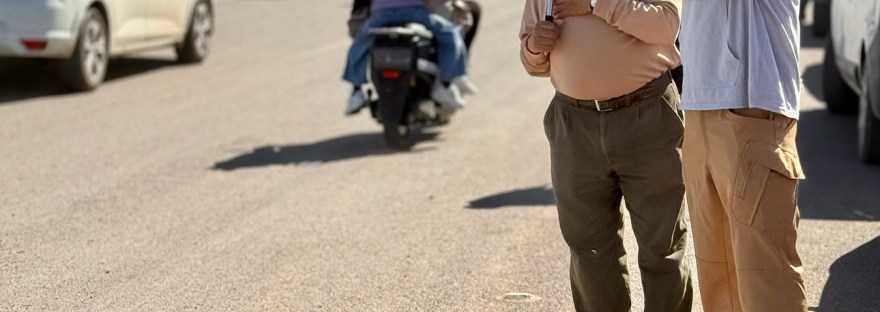
Time moves at a different pace in Morocco.
What started as a joke—converting stats and currency while jumping between languages—we laughed that our guide often misjudged travel time to our stops. “Morocco time” quickly became one of the most defining observations of the trip. At first, it felt situational—maybe tied to our schedule—but over time it became clear that this pace is embedded in the culture.
From watching shepherds standing on the roadside with nothing more to do than watch their sheep and the world go by, to traveling between cities where trip time is uncertain on secondary roads, there is a shared understanding that things will happen when they happen. Transportation is not always on demand as it is in the US. Many rely on hitching rides because they have no vehicle, which means you arrive when you arrive.
Even the infrastructure reflects this reality. Second-hand vehicles imported from Europe—often older and unreliable—are common. Breakdowns along the roadside are not unusual and don’t seem to disrupt the flow of daily life. Instead, they are simply part of it.
There is a mindset of eating when you can find food, sharing what you have, and traveling when there is a way. This slower pace can feel refreshing, especially compared to the constant urgency we experience at home. At the same time, it can also be challenging and limiting. You don’t get what you want when you want it, and that has to be okay. For me, it created a bit of a mental tension—I realize life in the US must become more sustainable, but also that life in Morocco is not always this way by choice.
Through conversation, I heard a recurring theme: many Moroccans, if given the opportunity, would leave. That was difficult to hear from such kind people with such a heart for others. There is also a perception that speaking Arabic can signal limited opportunity, while learning French or English opens doors to education and economic advancement.
There are broader systemic challenges as well. Access to clean water and other essential resources is limited in many regions. Historical efforts, including those influenced by the French and the US, have attempted to improve infrastructure, but the long-term impact appears uneven. They speak highly of the United States and seem to embrace our culture and kindness—something I did not fully expect, given how often Americans are perceived as entitled.
One of the most challenging aspects for me was understanding the difference between what people feel they need and what we, as outsiders, assume they need. Language barriers and cultural differences make this difficult to fully grasp.
While there has been investment in Morocco over time, economic growth appears inconsistent. It is unclear whether this is driven by government structure, gaps in education, limited resources, shortages of rain, skilled labor, or a combination of these factors.
Current statistics show that roughly 38 million people live in Morocco, and about 32% are under 18. That’s roughly one in three people. Many have opted out of public education because they don’t see the value. This was concerning to our group, as we saw middle school–aged youth playing in the streets late into the night. They are often playing soccer and not causing trouble, but their future can feel uncertain.
The disparity between urban and rural areas is especially noticeable. We quickly noticed the divide between the “haves” and “have-nots.” Poverty across communities is significant, and access to healthcare and infrastructure is limited. Health itself becomes a barrier to development, creating a cycle that is difficult to overcome.
At the same time, there are small pockets of wealth.
In the Béni Mellal region, we saw a community shaped by migration. Many individuals left in the 1970s and obtained work visas in countries like Italy. Today, they return seasonally, building vacation homes and reinvesting in the region. This creates a unique dynamic between those who left for opportunity and those who stayed.
One side of immigration that was a revelation for me is that those who leave often take their talent and skills with them, creating a deficit for the community. It shifted my perspective. I could not help but think of areas in Mexico where many hard-working individuals come to the US for better opportunities. I thought I had a decent understanding of US immigration, but this was an angle I had not previously considered.
Agri-tourism is also a growing economic driver. Visitors from Europe and the United States contribute to the local economy through travel and spending. However, it remains unclear how sustainable or equitable this model is in the long term, particularly in terms of reinvestment into local agriculture and communities that will need to support a growing youth population.
Nearly every agricultural sector we visited shared a similar concern: labor shortages. Despite average daily wages around $10 and widespread poverty, many young people are not interested in agricultural work. This was surprising. Some operations resist automation to preserve jobs for their communities, yet still struggle to find people willing to do the work.
A central takeaway from this experience is the importance of balance.
The pace and culture we live in within the United States can feel unsustainable—constantly accelerating, optimizing, and pushing for more. At the same time, a system that is too slow, uneducated, or unpredictable can limit opportunity and growth.
If we pursue automation and AI without intention, we risk disrupting balance. Conversely, if we slow everything down too much, we risk missing opportunities for development. The challenge is finding the right balance between progress and presence.
From a leadership perspective, this experience reinforced the importance of servant leadership. Strong systems require guardrails and structure, but they also require trust—allowing people to operate in ways that benefit the whole. Sustainable systems are those that empower individuals while maintaining alignment.
Another key concept discussed during the trip was prioritizing innovation before defaulting to technology. While technology is critical, there is value in first improving and adapting existing systems rather than immediately replacing them.
One statement that resonated throughout the experience was: “If you have no problems, you have a very big problem.” This reinforces that challenges are a natural and necessary part of growth, both personally and organizationally.
Beyond the structural and economic observations, one of the most meaningful aspects of this experience was the people. Not just the Moroccans, with a heart for their neighbors and a welcoming attitude toward Americans, but also the relationships built within our cohort. These relationships created a strong sense of connection and trust.
There was value in being uncomfortable, asking questions, and allowing vulnerability to drive learning. These shared experiences will have a lasting impact.
It is difficult to fully capture everything from this trip. The lessons extend beyond what can be written, photographed, or even described—many feeling almost spiritual at times.
However, it is clear that the experiences from this program—over the past two years and throughout this trip—will have a lasting impact not only on me, but also on my family and the organization that supported me.
The growth we experienced will continue to compound as we learn from each other and apply these lessons moving forward.
Thank you to everyone who made this journey possible!

 valeadersor.com